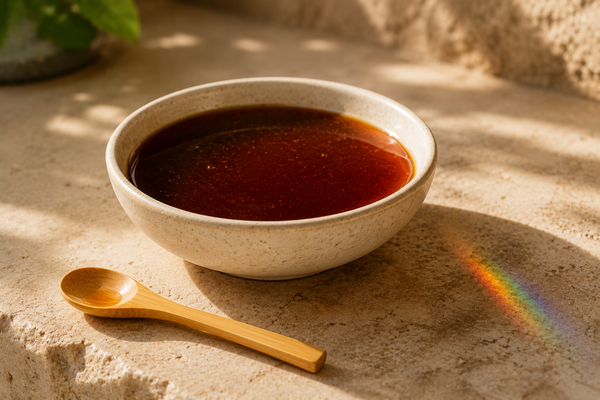
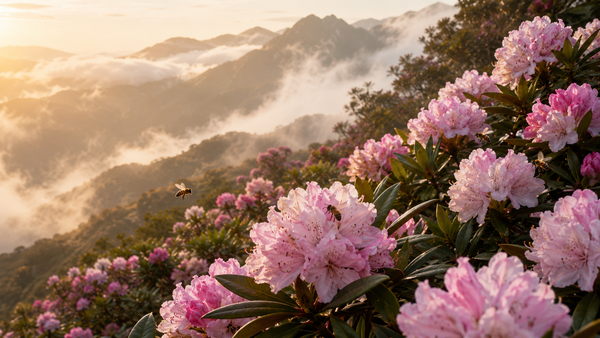
Mad honey is a rare type of honey produced when bees collect nectar from certain rhododendron flowers. Its effects come from grayanotoxins, natural compounds in those flowers that give the honey its characteristic warming, grounding quality.
This is the core difference from ordinary honey. While regular honey is used mainly as a sweetener, mad honey is taken in small amounts for its distinctive effects. It comes from two places: the high mountains of Nepal and the Black Sea region of Turkey, the only regions where grayanotoxin-bearing rhododendrons grow wild in the density a colony needs.
What Is Mad Honey?
Mad honey is rhododendron honey that naturally contains grayanotoxins. The compounds originate in the flowers themselves; nothing is added after harvesting.
Bees gather nectar from grayanotoxin-producing rhododendrons and carry it back to the hive. As the nectar becomes honey, the plant compounds remain in the finished product, and this is what gives the honey its bioactive properties.
The term does not refer to one standardized "mad honey strain." Different jars come from different rhododendron species, regions, elevations, and harvest seasons, and those variables affect color, flavor, and grayanotoxin concentration.
Other names for the same product include Himalayan mad honey, Nepalese mad honey, red honey, and deli bal, the Turkish name for honey from the Black Sea region. It should not be confused with honey infused with cannabis, mushrooms, or synthetic ingredients. A fuller breakdown of how these compounds behave is covered in this explanation of what mad honey is.
Where Does Mad Honey Come From?
The two places most closely associated with mad honey are Nepal and the Black Sea region of Turkey. Both have rhododendron-rich landscapes, but their geography, bee populations, and harvesting traditions produce different types of honey.
In Nepal, the honey is linked to remote Himalayan areas where giant Himalayan honey bees, Apis laboriosa, build large exposed nests beneath rocky overhangs and on steep cliff faces. These bees forage on wild mountain rhododendrons during seasonal flowering periods.
Nepalese jars are typically dark, earthy, and intense in flavor. The dramatic cliff-harvesting tradition behind them is a major reason this has become the best-known form of mad honey internationally.
Origin alone does not prove that a jar is genuine or establish its strength. Not all honey from Nepal or Turkey contains meaningful levels of grayanotoxins, and batches from the same region can still differ considerably.

How Is Mad Honey Made?
Production starts the same way as any flower honey: bees gather nectar, carry it to the hive, and transform it through enzymatic activity and water evaporation. The difference lies entirely in the nectar source, while the process itself is ordinary beekeeping.
In parts of Nepal, wild honeycombs are harvested from exposed cliff colonies. Honey hunters descend on rope or bamboo ladders and use long poles to cut sections of comb free, then carry the harvest back to the village to be separated from wax and debris. A closer look at how the honey is harvested in Nepal shows just how demanding this process is.
Processing stays simple from there. The comb may be pressed and strained by hand before the honey is stored or packed. No infusion, chemical alteration, or blending is needed, because the defining compounds arrive with the nectar.
Season matters too. Rhododendron flowering, weather, and the availability of competing flowers all influence how much rhododendron nectar enters a hive, which is one reason two harvests rarely taste or feel identical.

Regular Honey vs. Mad Honey
Regular honey and mad honey are both produced by bees and are composed mainly of natural sugars and water. The difference is that mad honey can also contain enough grayanotoxins to cause noticeable physiological effects.
| Feature | Regular honey | Mad honey |
|---|---|---|
|
Nectar source |
Produced from many different flowers, depending on the variety |
Produced when bees forage on certain grayanotoxin-containing rhododendrons |
|
Defining compounds |
Natural sugars, water, and plant-derived compounds |
Natural sugars, water, plant-derived compounds and naturally occurring grayanotoxins |
|
Typical use |
Used as a sweetener, cooking ingredient, or everyday food |
Taken primarily for its calming, warming or energising effects |
|
Reported benefits |
Provides a quick source of carbohydrate energy and is commonly used to soothe the throat |
Commonly associated with relaxation, stress relief, sleep support, pain management and a subtle lift in energy or mood |
|
Taste |
Usually sweet, with floral notes that vary by source |
Often sweet with earthy, bitter, woody or slightly medicinal notes |
|
Serving approach |
Commonly added freely to food, drinks and recipes |
Usually taken in smaller, measured servings with attention to the product’s guidance |
The most important difference is therefore chemical rather than visual. Dark honey is not automatically mad honey, and a bitter flavor does not prove that grayanotoxins are present. Laboratory analysis provides much stronger evidence than appearance or taste alone.
The Main Benefits of Mad Honey
Four reasons drive most interest in mad honey: pain management, stress relief, sleep support, and natural energy. Its reputation rests on centuries of use, the noticeable effects of its grayanotoxins and, in some areas, early research. Large human trials are still lacking, so it is best positioned as a specialty wellness food rather than a medical treatment.
Pain Management and Physical Comfort
Pain relief is one of the oldest uses of mad honey. It has long been taken for general aches, soreness and physical discomfort, the kind that follows demanding work, travel or exercise.
Early scientific evidence supports this as well. An experimental study found that grayanotoxin produced measurable analgesic activity in mouse models of acute pain and painful diabetic neuropathy. These are animal findings rather than proof of an effect in humans, but they place this use on firmer ground than anecdote alone.
In practice, it suits occasional physical discomfort rather than persistent pain. Ongoing, severe, or unexplained pain belongs with a healthcare professional.
Stress Relief and a Calmer Nervous System
Winding down is the most common reason for taking mad honey. A small amount works best at the end of a demanding day, when the goal is to release built-up tension, step away from mental overstimulation, and slow the pace.
The mechanism helps explain the feeling: grayanotoxins interact with sodium channels involved in nerve-muscle communication, which is why the effect registers through the whole body rather than as a short sugar lift. That said, the calmer state people describe is exactly that, a described state, not evidence that mad honey treats an anxiety disorder.
The effect is generally grounding rather than heavily sedating, which is what makes it usable during the day.
Sleep Support
For sleep, the appeal is making it easier to switch off. It works best for people who feel physically tense or mentally alert at bedtime, since the settling effect can smooth the transition into sleep and ease the restlessness that delays it.
Some users also report waking more refreshed, without the heaviness stronger sleep products can leave behind.
It is not a sedative, and controlled human research has not established it as an insomnia treatment. It is better described as a lighter form of sleep support for anyone wanting a calmer bedtime without adding another formulated supplement.
Natural Energy
For energy, mad honey is a strong option when a lift is wanted without coffee, energy drinks or synthetic stimulants. Like all honey, it contains glucose and fructose the body can use as readily available fuel, without the sharp spike and crash often associated with caffeine.
The two effects are worth keeping separate: the fuel comes from the honey's carbohydrates, while the grounding sensations come from its botanical source. It delivers a measured lift, not high-performance stimulation.

What Does Mad Honey Taste and Feel Like?
Mad honey usually tastes sweet at first, followed by notes that can be earthy, woody, bitter, sharp, or slightly medicinal. Some batches have a warm, lingering aftertaste that feels stronger than the flavor of ordinary floral honey.
Himalayan jars tend toward darker, bolder, earthier profiles, though the intensity varies from one harvest to the next. These are general tendencies rather than fixed rules, and botanical source, elevation, moisture, and storage all shape the final flavour.
Texture is equally variable. A jar may be thick and sticky, relatively fluid, or partially crystallized. Crystallization is a normal feature of real honey and does not automatically indicate that the product is fake or spoiled.
What mad honey feels like is harder to define because people respond differently. Common descriptions include warmth, relaxation, heaviness, greater awareness of the body, or a slower mental pace. It is not a conventional stimulant, and it should not be expected to work like an energy supplement.
The term "psychedelic honey" appears frequently in marketing, but that wording sets unrealistic expectations. Mad honey contains no THC, CBD or psilocybin, and a responsible seller will not guarantee hallucinations, a "trip" or an extreme high.
Too much grayanotoxin produces a very different picture: dizziness, nausea, sweating, weakness, confusion, low blood pressure and a slowed heartbeat. The line between a subtle experience and an adverse reaction cannot be judged by taste alone.
What to Look for When Buying Mad Honey
Because every harvest varies, choosing the right seller matters just as much as choosing the honey itself. A credible product should make it easy to understand where the honey came from, how it was assessed, and how it should be used.
Look for:
-
A clearly identified harvesting region rather than vague "Himalayan" branding
-
Independent testing for authenticity and grayanotoxin content
-
A process for rejecting batches that do not meet the seller's standards
-
Clear and conservative serving guidance
-
Transparent sourcing connected to established honey-harvesting communities
-
Realistic descriptions that do not promise extreme effects or medical outcomes
Real Mad Honey is built around these standards. Its honey is sourced through trusted partners connected to traditional harvesting communities in Nepal, and selected batches are assessed before they are offered for sale. Anything unsafe or inconsistent is rejected.
Each order also includes clear serving guidance, which makes it easier to approach the honey with control from the first jar. The emphasis is on traceable origin and responsible use rather than on selling the "strongest" possible product.
What that adds up to is a jar whose contents are knowable before purchase rather than after. That is the practical difference from generic products, which rely on dramatic branding and vague mountain origins without ever explaining what is inside.

The Takeaway: What Makes Mad Honey Different
The practical takeaway is simple: treat mad honey as a potent, naturally variable specialty food rather than an everyday sweetener. Every harvest differs slightly with origin, season, and floral mix, which is part of the appeal and exactly why responsible testing matters.
It fits best for someone curious about a traditional wellness food with a noticeable, grounding character: an evening wind-down, an easier transition into sleep, or a caffeine-free lift. It is the wrong choice for anyone expecting a psychedelic experience, looking to treat a medical condition, or planning to eat it by the spoonful like table honey.
Origin and evidence should drive the purchase decision. A jar with a named harvesting region, independent testing, and conservative serving guidance is worth more than a stronger-sounding product with none of the above. Sellers promising guaranteed effects or miracle benefits are the clearest signal to look elsewhere.