What Does Mad Honey Feel Like?
Mad honey is usually described in terms of how the body feels rather than dramatic changes in perception. Some people report a calmer physical state, mild warmth, a slower pace or a sense of being more present and aware. Light-headedness can also occur, while others notice only a subtle shift or very little at all.
That variation is part of the experience. Mad honey is a natural product, so both the concentration of GTX in the honey and the person consuming it influence the response. A serving that feels noticeable to one person may feel much milder to another.
The key distinction is between mild effects and signs of excessive exposure. Pronounced dizziness, nausea, weakness, sweating or feeling faint are not simply a stronger version of the experience someone is looking for; they indicate that grayanotoxin is affecting the body more significantly.

What Causes the Effects of Mad Honey?
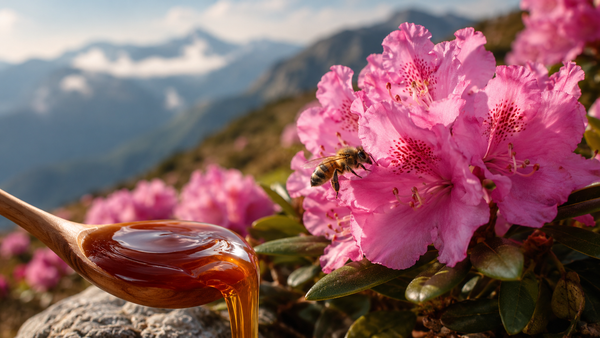
Grayanotoxins are the naturally occurring compounds responsible for mad honey's distinctive effects. They are found in the nectar of certain rhododendron species, and when bees forage heavily on those flowers, some GTX remains as the nectar is turned into honey. This chemical difference, rather than colour, bitterness or origin alone, is what separates genuine mad honey from ordinary honey, and what mad honey is and how it differs covers that distinction in full.
Inside the body, grayanotoxins interact with voltage-gated sodium channels involved in electrical signalling across nerve and muscle cells. That action can influence physical sensation, alertness, blood pressure and heart rate, which helps explain why the experience tends to feel more bodily than perceptual.
Is Mad Honey a Psychedelic or Hallucinogen?
Mad honey is not considered a psychedelic or hallucinogen in the conventional pharmacological sense. Classic psychedelics such as psilocybin and LSD act primarily through serotonin systems in the brain, while grayanotoxins act through sodium channels throughout the body.
That difference is important because terms such as “psychedelic honey” can create the wrong expectation. Mad honey is not typically associated with vivid visual distortions or the major perceptual changes linked to classic psychedelics. It is more accurately described as a natural honey containing biologically active compounds that can produce a noticeable but highly individual shift in physical state and awareness.
How Strong Can Mad Honey Be?
There is no single strength that applies to all mad honey. GTX concentration can vary from one harvest and batch to another because factors such as rhododendron species, altitude, flowering conditions, weather, timing of the harvest, and where bees forage all influence the finished honey. Where mad honey comes from covers how those conditions differ between harvests.
That natural variation is part of genuine wild-harvested mad honey rather than a flaw. What matters is whether the strength of a specific batch is known rather than assumed.
Appearance is not a reliable guide. Darker honey is not automatically stronger, and bitterness, thickness or flavour cannot tell you the actual GTX concentration. Marketing terms such as “extra strong” or “high potency” are equally limited unless they are backed by testing.
Laboratory analysis is the practical way to understand how a particular batch compares with another. It replaces guesswork with something measurable, which matters much more than how dramatic the product looks or sounds.
How Long Do the Effects of Mad Honey Last?
The noticeable effects of mad honey can continue for several hours, but there is no fixed duration that applies to everyone. The amount consumed, GTX concentration in the batch, individual sensitivity, metabolism, and whether someone has recently eaten can all influence how long the effects last.
This makes online anecdotes a poor universal benchmark. Someone else's serving size and timeline may involve a different batch and a different individual response. Allowing enough time to understand how a particular serving affects you is more sensible than assuming another person's experience will apply exactly.
What Happens If You Take Too Much Mad Honey?
Excessive consumption can lead to grayanotoxin poisoning rather than simply creating a stronger version of mad honey’s milder effects. As GTX exposure rises, symptoms can include pronounced dizziness or light-headedness, nausea, cold sweats, weakness, low-blood-pressure symptoms, and feeling faint. More honey therefore does not simply mean a stronger desirable response; it means greater grayanotoxin exposure and a higher chance of an uncomfortable reaction.
A cautious approach is to start with a small serving, wait long enough to assess the effect before considering any more, and avoid stacking servings quickly in pursuit of a stronger experience. Serving guidance should always be followed carefully, particularly because GTX concentration and individual sensitivity can vary.
If too much has been consumed, take no more, drink water, rest somewhere safe, and monitor how you feel. Severe symptoms, fainting, significant changes in heart rate or blood pressure, or symptoms that do not improve should be treated as a reason to seek medical attention.
How to Judge the Quality and Potency of Mad Honey
Quality and potency are best judged through evidence rather than appearance. Traceable sourcing shows whether the honey comes from an environment where the relevant rhododendron species grow, while batch-level testing gives objective information about the GTX present in the product.
A darker colour, thicker texture or stronger taste may make a jar look more distinctive, but none of those things can confirm how much GTX it contains. The same is true of words such as “wild,” “premium” or “potent.” Without supporting evidence, they are simply descriptions.

What to Look for Before Buying Mad Honey
A credible mad honey seller should be able to explain where the honey comes from, what testing has been carried out and how the product should be approached responsibly. The strongest signals are the ones a buyer can actually verify rather than simply being asked to trust.
Batch-Specific Testing
A generic “lab tested” claim tells you very little unless it is connected to the actual batch being sold. Batch-specific reports provide a clearer picture of the GTX profile and make it possible to understand how one harvest compares with another.
Traceable Sourcing
Origin matters because genuine mad honey depends on bees foraging in areas where the right rhododendron species grow. A seller should be able to explain the harvesting region and supply chain rather than relying on vague terms such as “Himalayan” or “wild.”
Responsible Serving Guidance
Clear guidance is another sign that the seller understands the product. Mad honey should not be marketed around chasing the strongest possible effect, and buyers should be given measured instructions that reflect the fact that individual response and batch composition can vary.
Real Mad Honey combines these elements through traceable Nepalese sourcing, published batch-level testing, a defined rejection standard and measured serving guidance. The goal is not to promise an identical experience from every jar, but to give customers enough information to know what they are buying and approach it with control.
Bottom Line: What to Expect From Mad Honey
Mad honey is best understood as a naturally variable product that can produce subtle changes in physical sensation and awareness rather than a predictable recreational “high.” Some people may notice a calmer body, a slower pace, mild warmth or light-headedness, while others may feel very little. The experience depends on both the individual and the GTX concentration in the particular batch.
What matters most is knowing what you are consuming. Traceable sourcing, batch-specific testing and clear serving guidance give a far better indication of product quality than colour, taste or exaggerated potency claims. Mad honey should be approached for what it is: a distinctive natural honey with biologically active compounds, not as a standardized intoxicant with a guaranteed effect.