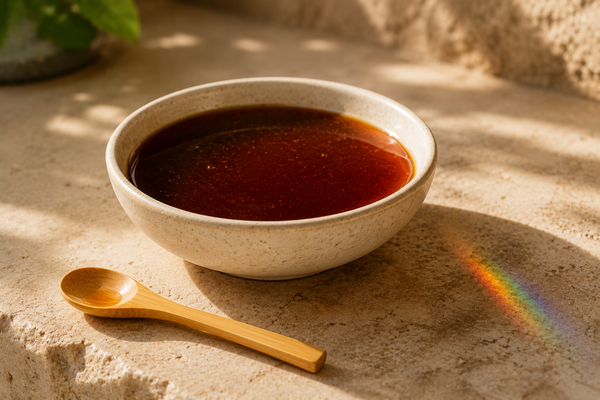
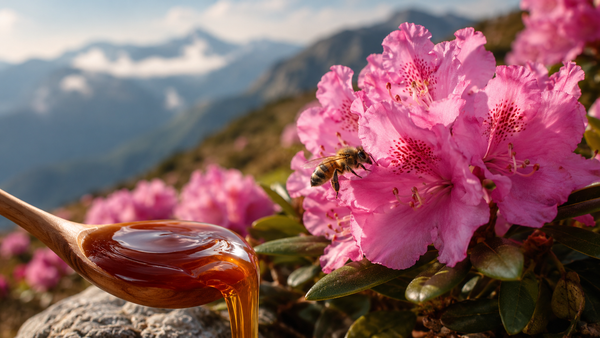
Mad honey starts with rhododendrons, but the relationship is more complex than a single flower producing a single type of honey.
Only certain species contain the naturally occurring plant compounds associated with mad honey. Those plants must also grow densely enough, flower at the right time, and sit within reach of an active bee colony. Even then, the finished honey may contain nectar from several other plants growing nearby.
Understanding the plant behind mad honey therefore means looking beyond its name. Species, habitat, flowering season, and surrounding vegetation all influence what eventually reaches the comb.
What Role Do Rhododendrons Play in Mad Honey?
Rhododendrons provide the nectar that separates mad honey from ordinary floral honey. Some species naturally contain grayananes, a family of plant compounds that includes the grayanotoxins most commonly associated with mad honey.
Bees make mad honey through the same basic process used to produce any other honey. They collect nectar from flowers, carry it back to the colony, and gradually reduce its water content before storing it in the comb. The difference lies in the nectar entering that process.
When bees forage heavily on the relevant rhododendrons, small amounts of the plant’s compounds can pass into the honey. Researchers most often study grayanotoxins I and III, although rhododendrons contain a wider and more complicated range of related compounds.
This does not mean that every hive beside a rhododendron produces mad honey. Bees forage across the surrounding landscape and choose between whatever flowers are available. A few isolated shrubs may make little difference, while a hillside covered in flowering rhododendrons can become a major seasonal nectar source.
The plant provides the necessary starting point, but the surrounding ecology determines how clearly it appears in the harvest.
Which Rhododendron Species Produce Mad Honey?
The genus Rhododendron contains many different plants, but only a smaller number are consistently associated with grayanotoxin-containing honey.
The best-documented species are Rhododendron ponticum and Rhododendron luteum. Both grow naturally in Turkey and surrounding areas, and both have been repeatedly connected with mad honey from the eastern Black Sea region. Rhododendron flavum, a name that appears in some older studies and articles, is now treated as a synonym of Rhododendron luteum.
The Nepalese picture is less straightforward. Rhododendron arboreum is native to Nepal and is one of the most recognisable rhododendrons in the Himalayan landscape, but it should not automatically be presented as the sole source of every Nepalese harvest. Studies of Nepalese honey suggest that the floral profile can be mixed, with rhododendron pollen appearing alongside pollen from other mountain plants. Further research is still needed to identify the exact species contributing to individual harvests.
| Species | Growth and native range | Role in mad honey production |
|---|---|---|
| Rhododendron ponticum | A shrub or tree native from southeastern Europe through Turkey and towards the Caucasus | One of the principal botanical sources linked with Turkish Black Sea mad honey |
| Rhododendron luteum | A temperate shrub native from parts of eastern Europe through Turkey and the Caucasus | Another major Turkish source, also historically called R. flavum |
| Rhododendron arboreum | A tree native across Nepal and other parts of the Himalayan region | An important part of the Nepalese rhododendron landscape, although individual honey harvests may reflect several local species |
The important distinction is between association and certainty. A species may grow in a famous mad honey region without being the only flower visited by the bees. Wild honey records a landscape, not simply the name of its most recognisable plant.
What Growing Conditions Do Mad Honey Rhododendrons Need?
The rhododendrons associated with mad honey tend to thrive in cool, moist environments where the soil is acidic and rich in organic matter. Forest edges, shaded slopes, and mountain valleys often provide the combination of rainfall, drainage, and moderate temperatures these plants need.
Altitude can also influence how they grow and flower. Cooler conditions may delay blooming, while lower or warmer areas can enter the flowering season earlier. This creates short, localised windows in which large numbers of blossoms are available to bees at the same time.
Dense plant growth matters as much as the habitat itself. A few scattered rhododendrons are unlikely to dominate the bees’ forage when many other flowers are available. Forest understories and mountain slopes covered in the relevant species provide a much more concentrated nectar source.
Altitude can shape these habitats by affecting temperature, moisture and the types of vegetation that grow nearby. However, elevation alone does not produce mad honey. Suitable soil, reliable moisture and enough flowering rhododendrons must all occur within reach of an active colony.
This combination helps explain why mad honey is connected with particular mountain landscapes rather than every region where rhododendrons grow.

How Flowering Season Shapes the Harvest
Rhododendron nectar is only available while the plants are in bloom. That limited flowering period creates a seasonal window during which bees may collect a higher proportion of nectar from the relevant species.
The strength of the bloom can change from one season to another. Rainfall, temperature, sunlight and wind affect flower development, nectar production and the number of hours in which bees can forage. A hillside may bloom heavily one year and provide a shorter or less productive flowering period the next.
The order in which plants flower is equally important. If rhododendrons open before other abundant nectar sources, bees may forage on them more consistently. If chestnut trees, herbs and other mountain flowers bloom at the same time, the honey can reflect a broader mixture.
Harvest timing then decides which part of that seasonal record is removed from the hive. Honey collected soon after a concentrated rhododendron bloom may differ from honey left in the comb while later plants begin flowering.
This is one reason wild mad honey cannot be reduced to a permanent recipe. Each harvest captures a particular moment in the landscape.

How Rhododendron Species Shape the Honey
Rhododendron species differ in more than where they grow. Their nectar can contain different combinations and concentrations of grayananes, along with distinct aromatic compounds, plant acids, and other minor components.
Research has found substantial differences between grayanotoxin measurements taken from different rhododendron species, plant parts, and geographical samples. Even nectar from the same species may not show identical concentrations when collected in different environments.
Species can also influence the amount and type of pollen entering the honey. Pollen analysis is commonly used to investigate botanical origin because the microscopic grains left in honey can help identify which plants were flowering near the colony. Recent research suggests that honey containing more rhododendron pollen may also show higher measured levels of GTX III, although pollen alone cannot determine the complete chemical profile of a batch.
The effect on flavour is harder to isolate. Bitterness, aroma, sweetness and colour may all be influenced by the flower source, but they are also affected by other nectar plants, moisture, storage and natural batch variation.
A darker jar is not automatically more potent, and bitterness cannot replace laboratory analysis. Sensory qualities can tell the story of a harvest, but they cannot provide an exact chemical reading.
What to Look for When Choosing Mad Honey
Three things are worth checking, and the botany explains why each one matters. The first is a named harvesting region rather than a vague mountain reference, since knowing where a harvest came from establishes which plants were within reach of the colony. The second is a stated harvest period, because the flowering window determines how much of the forage came from rhododendrons. The third, and the only one that describes the honey itself, is a published laboratory result for the batch on sale.
Everything covered so far shapes the honey before it reaches a jar. Species determines which compounds are available, habitat and altitude determine how densely those plants grow, and the season determines how much of the forage came from them. None of it can be read from the outside, though. Two jars from the same hillside in different years sit at the end of different botanical stories, and nothing visible on the label distinguishes them.
That is what batch-level testing resolves. Measured figures for GTX I and GTX III describe the specific honey in the specific jar, which is the one thing the plant, the region and the harvest date cannot supply between them. Colour and bitterness cannot stand in for it either, since both are shaped by moisture, storage and other nectar plants as much as by grayanotoxin content.
Real Mad Honey meets all three. Its honey is wild-harvested above 3,500 metres in the Himalayas through established Nepalese honey-hunting communities, collected during the short seasonal windows when the rhododendrons bloom, and every batch is analysed by Eurofins before sale, with the results published against the batch on the shelf. Anything inconsistent is rejected, and clear serving guidance ships alongside. Character still varies from one harvest to the next, exactly as the botany predicts, and the reports are what make that variation knowable rather than merely acknowledged.

Conclusion: The Flower Behind Mad Honey’s Potency
Rhododendrons give mad honey its defining botanical foundation, but the flower is only the beginning of the story.
Species determines which plant compounds may enter the nectar. Geography determines where those species grow. Flowering season controls when they become available, while weather and neighbouring plants affect what else the bees collect.
The finished honey is the result of all those factors working together. That is why authentic mad honey varies between origins, seasons and individual batches.
Understanding the rhododendron behind it makes those differences easier to appreciate. It also explains why transparent sourcing and batch-level information are more meaningful than vague claims about mountain origin or extreme strength.
For a broader introduction to its history, composition and traditional use, explore the complete guide to mad honey.