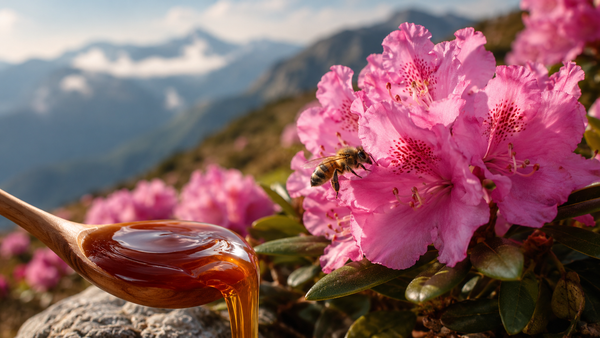
Mad honey is not a psychedelic, and almost everything sold under that description is misrepresenting what it does. The compounds responsible act on the body rather than on perception, and the experience people describe is physical rather than visual.
The reputation is older and more interesting than the marketing, though. Ancient armies were incapacitated by it, travelers wrote about it for centuries, and a modern wave of viral clips revived the idea that a spoonful produces something extraordinary. Understanding where that came from explains why the expectation persists long after the pharmacology stopped supporting it.

Where the Psychedelic Reputation Came From
The historical record is genuinely dramatic, which is much of the problem. In 401 BC, Greek soldiers retreating through what is now Turkey ate honey from local hives and were incapacitated for days, and Xenophon's account describes them behaving as though drunk or deranged. Several centuries later, forces under Pompey were reportedly disabled by honey deliberately left in their path.
Those accounts describe grayanotoxin poisoning rather than a psychedelic experience, and the distinction was lost long before anyone was in a position to make it. Soldiers collapsing, vomiting, and losing coordination were described in the language available at the time, which had no way of separating a cardiovascular event from an altered state.
The modern revival came through media rather than through anything new about the honey. Documentary footage of Himalayan cliff harvesting circulated widely, podcast segments introduced mad honey to audiences who had never encountered it, and the framing that spread was closer to a curiosity than to a food. Once the word psychedelic attached itself, it proved considerably easier to repeat than to correct.
Is Mad Honey a Hallucinogen?
No, not in the sense the term is normally used. A hallucinogen produces perceptual changes, meaning things seen, heard, or experienced that are not present, and mad honey does not reliably produce any of that at the quantities people consume. What it produces instead sits in the body. Warmth spreading through the chest, a tingling around the lips and tongue, muscular relaxation, and a slower mental pace are the sensations that recur across accounts, and none of them is perceptual in the way the term hallucinogen implies.
Classification supports the same conclusion. Grayanotoxin has never been scheduled as a hallucinogen or as anything else, and mad honey is regulated as a food rather than as a psychoactive substance, which reflects what it is rather than a gap in the law. The broader picture of what mad honey is covers the compounds involved in more detail.
Where the confusion has some footing is that the honey does something. It is not inert, the effects are real, and a person expecting nothing will notice a difference. The gap is between noticeable and psychedelic, which are not the same category of experience.

Why Grayanotoxins Are Not Psychedelics
The mechanism is the clearest answer. Grayanotoxins bind to voltage-gated sodium channels, the microscopic gates that let nerve and muscle cells fire electrical signals, and hold them open longer than usual. That slows signaling across the body and shifts autonomic balance toward the state associated with rest.
Classic psychedelics work through an entirely different route, acting on receptor systems in the brain that govern perception. The two have no mechanism in common, which is why the experiences do not resemble one another and why comparing them tends to mislead rather than clarify.
The practical consequence is that the effects register everywhere rather than in perception specifically. Sodium channels exist in every excitable tissue, so the response involves the heart, the muscles, and the nervous system at once, and what people describe is a body-wide shift rather than a change in what they see or think.
Can Mad Honey Cause Hallucinations?
At ordinary servings, no. The quantities people take for the described effects do not produce perceptual changes, and accounts of mad honey experiences overwhelmingly describe physical sensations rather than visual or auditory ones. At high exposure, the picture changes, though not in a way anyone should be seeking. Confusion, disorientation, and altered mental status appear in the clinical literature on grayanotoxin poisoning, alongside dizziness, nausea, sweating, low blood pressure, and a slowed heart rate. Those are symptoms of a cardiovascular event rather than a psychedelic experience, and they arrive with everything else that comes with poisoning.
That distinction matters more than any wordplay about whether disorientation counts as a perceptual change. Someone confused because their blood pressure has dropped sharply is not having an experience worth pursuing, and the accounts of soldiers behaving strangely in antiquity describe exactly this rather than anything visionary.
Anyone experiencing pronounced dizziness, nausea, sweating or faintness after consuming mad honey should stop, rest and seek medical attention if symptoms do not settle.
What People Actually Report
The gap between what mad honey is marketed as and what buyers describe is the clearest evidence available, and it appears consistently across independent accounts rather than in any single source.
| Commonly reported | Rarely or never reported |
|---|---|
| Warmth spreading through the chest and limbs | Visual distortions or hallucinations |
| Tingling on the lips and tongue | Changes in how time is perceived |
| Physical relaxation and released tension | Altered sense of self |
| A slower, calmer mental pace | Closed-eye imagery |
| Mild mood lift, described as a warm glow | Anything resembling a psychedelic experience |
| Easier sleep when taken in the evening | Perceptual changes of any kind |
A smaller number of accounts mention senses feeling slightly heightened, with colors or sounds seeming richer, and these are consistently described as subtle rather than as anything approaching distortion.
The comparisons people reach for are telling. Meditation, a sauna, a deep massage, and a glass of wine come up repeatedly, while comparisons to psychedelics appear mainly in marketing rather than in accounts from people who have tried it.
Why Mad Honey Is Still Sold as Psychedelic
Because it sells, and because nothing prevents it. Mad honey occupies a category with no compositional standard and no labeling requirement specific to it, so a seller can describe a jar in whatever terms move it. The word carries commercial weight that accuracy does not. Psychedelic honey attracts attention, generates search traffic, and justifies a premium, while a natural honey containing biologically active compounds describes the same product and interests fewer people.
The cost falls on buyers and on the product's reputation. Someone arriving with psychedelic expectations experiences a calm evening and concludes the honey is fake or weak, which is the single most common complaint in customer reviews and which stems from the description rather than the honey. Sellers making the strongest claims tend to be the ones publishing the least about what is actually in the jar.
A more reliable signal is the opposite of the one most marketing offers. A seller describing measured effects, publishing batch figures and setting conservative expectations is describing something they have tested, while one promising an extreme experience is selling the story rather than the contents.
What to Expect Instead
The honest description is narrower than the marketing and more useful. Mad honey produces a warm, grounded, physically relaxed state that arrives gradually and fades over several hours, closer to winding down than to anything altered. Onset is slow rather than sudden. Effects build over roughly half an hour to an hour rather than arriving at once, which catches out people expecting something immediate and leads some to take more before the first serving has done anything.
Variation is part of the product. Grayanotoxin concentration differs between harvests depending on which rhododendrons the bees worked, the altitude, and the season, and the same serving from two jars can feel noticeably different. Where mad honey comes from explains why those conditions vary so much between batches.
Expectations shape the experience more than most people account for. Someone anticipating a psychedelic will find a calm evening disappointing, while someone expecting a distinctive traditional food with a noticeable physical effect will find it delivers exactly that.

Buying From a Seller Who Describes It Honestly
How a seller talks about mad honey is a reasonable indication of how they handle it, since accurate description and careful sourcing tend to travel together. Five signals are easy to check before ordering:
-
Measured language rather than extreme claims. Descriptions of warmth, relaxation and a slower pace reflect what the product does, while promises of hallucinations or an intense high do not.
-
Published batch figures. Grayanotoxin content varies between harvests, and a seller that has measured it can publish the numbers for the jar being sold.
-
Named sourcing. A stated harvesting region and community indicates a supply chain that is known rather than assumed.
-
Conservative serving guidance. Instructions built around small amounts and waiting suggest a seller who understands the product rather than one selling intensity.
-
Honest acknowledgment of variation. A jar presented as identical to every other is describing something other than a wild seasonal harvest.
Real Mad Honey meets those standards, with honey wild-harvested in the Himalayas through established Nepalese honey-hunting communities, every batch analyzed by an independent laboratory before sale and the results published against the batch on the shelf, and batches falling outside the accepted standards rejected rather than blended into the next one.
Conclusion: What Mad Honey Actually Does
Mad honey is a natural food containing compounds that affect the body, and that is the whole of it. Grayanotoxins slow nerve and muscle signaling, which produces warmth, physical relaxation, and a calmer pace, and none of that involves the perceptual changes the word psychedelic describes.
The reputation traces back to genuine historical incidents that were poisonings rather than experiences, amplified by modern coverage that found the story more compelling than the substance. Nothing about the honey changed in the intervening centuries; only the language used to describe it did.
For anyone deciding whether to try it, the useful reframing is to stop asking whether it produces a high and start asking what is in the jar. A tested batch with published figures delivers a predictable version of a modest experience, which is what mad honey has always actually been.