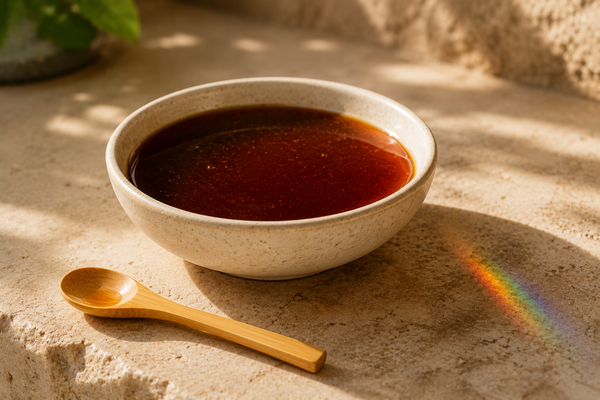
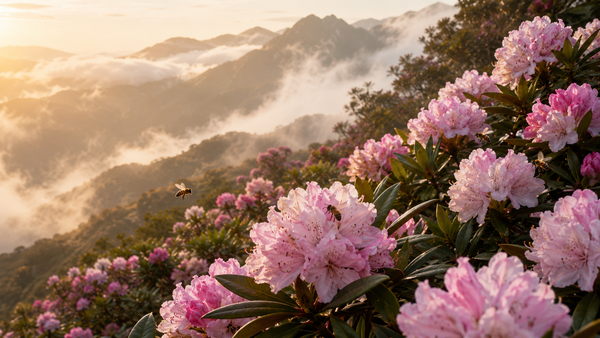
Mad honey contains the same basic ingredients as other natural honey, including sugars, water, enzymes, organic acids, and plant-derived compounds. Its defining difference is the presence of grayanotoxins, a group of naturally occurring compounds carried into the honey from certain rhododendron flowers.
These compounds are responsible for the warmth, physical relaxation and other noticeable effects associated with mad honey. They also explain why one harvest can differ from another and why origin, flower source and batch testing matter more than colour or flavour alone.
What Does Mad Honey Contain?
Mad honey shares the same basic composition as other natural honeys, with one important difference: it contains naturally occurring grayanotoxins. Fructose and glucose make up the largest share, followed by water and smaller quantities of enzymes, amino acids, organic acids, minerals, pollen and aromatic plant compounds. The precise balance varies with the flowers visited by the bees, the surrounding environment and the way the honey is harvested and stored.
What turns rhododendron honey into mad honey is the presence of grayananes carried over from the nectar. Grayanotoxins belong to this wider family of plant compounds. Researchers have identified many different grayananes in Ericaceae plants, with a smaller group found in or associated with honey.
| Component | Its role in mad honey |
|---|---|
| Fructose and glucose | Form the sweet, energy-containing base of the honey |
| Water | Influences thickness, stability and texture |
| Organic acids and volatile compounds | Contribute to acidity, aroma and flavour |
| Enzymes, minerals and pollen | Reflect natural honey production and botanical origin |
| Phenolic compounds | Contribute to colour and the wider plant-derived profile |
| Grayananes | Include the grayanotoxins that distinguish mad honey from ordinary honey |
Mad honey is therefore not ordinary honey infused with an additional ingredient. Its unusual chemical profile begins with the nectar collected by the bees.
What Are Grayanotoxins?
Grayanotoxins are naturally occurring polyhydroxylated diterpenes produced by plants in the Ericaceae family. Rhododendrons are their best-known source, although related compounds have also been identified in plants such as Pieris, Agarista and Kalmia.
Grayanotoxins are a group of closely related compounds, not a single substance. The main types found in mad honey are known as GTX I, GTX II and GTX III. Researchers focus most often on GTX I and GTX III because they are the forms most commonly detected and measured in honey.
The plants produce these compounds themselves. Bees do not create grayanotoxins, nor are the compounds introduced during packing or processing. When bees gather nectar and pollen from particular rhododendrons, small quantities move with the floral material into the hive and remain present as the nectar is converted into honey.
That process is what gives mad honey its unique compounds. Honey can be dark, raw, or collected in the mountains, but without nectar from the right rhododendron flowers, it will not contain the same grayanotoxins.

How Do Grayanotoxins Affect the Body?
Grayanotoxins interact with voltage-gated sodium channels. These microscopic channels help nerve and muscle cells create and transmit electrical signals. The compounds prevent the channels from closing normally, leaving affected cells in a prolonged activated state.
Because sodium channels are present throughout excitable tissue, the response is not limited to one part of the body. Changes can be felt through the nervous system, muscles, and cardiovascular system. At lower exposure, people may describe warmth, a slower mental pace, or reduced physical tension. Stronger exposure can produce dizziness, nausea, weakness, low blood pressure, or a slowed heart rate.
The same underlying mechanism can therefore produce both the qualities people seek and the unwanted effects associated with consuming too much. Serving size, individual sensitivity, and the grayanotoxin concentration of the batch all influence where the response falls along that range.
For a broader explanation of where mad honey comes from, why it contains grayanotoxins and how it is used responsibly, read this guide to mad honey.
How Is Rhododendron Honey Different?
Rhododendron honey is a botanical label. It describes where the nectar came from, in the same way that manuka, acacia, or clover honey describe a floral source. Mad honey is a chemical outcome, defined by grayanotoxins being present at levels high enough to produce noticeable effects. The two overlap, but they are not the same thing, and the difference matters at the point of purchase.
The genus Rhododendron includes more than 800 recognised species, growing everywhere from sea level to high alpine slopes. Their chemistry is not uniform. Some species are closely tied to grayanotoxin-containing honey, others produce related compounds at levels too low to register, and many produce nothing of the kind. A honey can be entirely rhododendron-derived and still contain no meaningful grayanotoxin content at all.
That has a practical consequence for anyone reading a label. The words "rhododendron honey" confirm a floral source and nothing more. They say nothing about which species the bees visited, how much of the harvest came from those flowers, or what concentration ended up in the jar. Honey sold under that description across Europe is often ordinary table honey from species with no grayanotoxin activity, priced accordingly.
Testing bears this out starkly. A study of sixty Nepalese mad honey samples found measurable grayanotoxin in only thirty-three of them, and among those the concentrations spanned roughly an eightyfold range, from 0.75 to 64.86 µg/g for GTX I. Close to half the samples carried the name and contained nothing of consequence.
Both kinds of label share the same weakness. Describing honey as rhododendron-derived is a claim about flowers, and describing it as mad honey is a claim about chemistry, but neither is self-proving. The difference is that a chemical claim can be settled outright by measurement, which is why the batch report matters more than either description.
How Flower Source Changes Grayanotoxin Levels
The specific flowers behind a harvest explain why grayanotoxin levels differ so widely from one jar to the next, even when every one of them starts with rhododendrons.
Two species dominate the research, and the contrast between them is instructive. Rhododendron ponticum and Rhododendron luteum, the purple-flowered and yellow-flowered shrubs of the Black Sea region, are the most closely studied sources of grayanotoxin-containing honey, largely because they grow in continuous stands that can dominate whatever else is in bloom nearby. Himalayan colonies work differently, collecting from a wider mix of local rhododendrons across a range of elevations, so what the bees gather changes more noticeably from one valley and season to the next, and how those high-altitude harvests are collected is a story in itself.
The compounds exist in these plants for reasons that have nothing to do with honey. Grayanotoxins are understood to work as a chemical defence against insects and grazing animals, and the same property that puts off a browsing herbivore is what makes the honey bioactive in humans. They are not harmless to bees either. Research suggests high concentrations in pollen can put bees off collecting it, which is one reason the amount reaching a hive depends so much on what else is flowering at the time.
Floral source shapes more than grayanotoxin content. It also affects colour, aroma, bitterness, texture and the balance of other plant compounds, which is why two genuine mad honeys can look and taste quite different without either being diluted or mislabelled. A darker jar and a paler one can sit closer in measured strength than their appearance suggests.

Why Potency Varies Between Harvests
Mad honey is a wild agricultural product rather than a manufactured formula, and its grayanotoxin content is settled in the field long before the honey reaches a jar. What happens during a single flowering and collection period decides the outcome.
Several factors influence the final profile:
-
How thickly the relevant plants flowered that season
-
How much competing nectar was available from other plants nearby
-
Regional climate, elevation, rainfall and temperature during the flowering window
-
Where the bees chose to forage and what they brought back
-
Whether honey from different combs, colonies or sites was combined
These conditions shift from season to season and from one collection area to the next, so two harvests from the same country, sometimes even the same valley, can contain quite different proportions of GTX I, GTX III and related compounds.
What happens after the harvest matters far less. Grayanotoxins are stable compounds and are not thought to break down much in ordinary storage, so a jar kept sealed in a cool cupboard should hold the profile it had at packing. Crystallisation, which affects most raw honey over time, is a change in the sugars rather than the chemistry, and a crystallised jar is neither spoiled nor weaker. Sustained high heat is the one thing worth avoiding, since it degrades honey generally, though its specific effect on grayanotoxin content has not been well studied.
Strength cannot be judged from how dark, bitter, or thick a honey is. Those qualities come from the botanical source, moisture, and storage rather than from concentration, and a mild honey can be dark while a potent one can be pale. Laboratory analysis is the only way past guesswork.
Variation is part of what authentic mad honey is, since every harvest reflects a different combination of flowers and conditions. The realistic goal is not to make every batch identical, which would mean processing the honey into something it is not, but to test each one, share what was found, and give guidance that accounts for the difference.
How to Choose Mad Honey
Choosing mad honey starts with transparency. The seller should clearly identify where the honey was harvested, explain how the batches are assessed, and provide practical guidance for using the product. Vague claims about extreme strength are less useful than clear information about the individual harvest.
Batch-level testing is especially important because grayanotoxin concentrations naturally vary. Testing does not make every jar identical, but it helps confirm what was found in the batch and whether it meets the seller’s standards. Published reports also give buyers more confidence than colour, bitterness, or origin claims alone.
Real Mad Honey combines traceable sourcing with third-party GTX testing and clear serving guidance. Its honey is wild-harvested above 3,500 metres in the Himalayas through established Nepalese honey-hunting communities, and every batch is analysed by Eurofins for GTX I and GTX III before sale, with results published against the batch on the shelf. Each harvest keeps its own natural character, while batches falling outside the accepted standards are not offered at all.

Verdict: What Makes Mad Honey “Mad”
Mad honey remains honey at its foundation. Its sugars, water, enzymes, and plant compounds are familiar features of many natural honeys. Grayanotoxins are the feature that changes its chemical identity and gives it effects beyond sweetness.
Those compounds begin in specific rhododendron flowers, pass into the hive with nectar, and vary according to the plants and conditions behind each harvest. This is why the name on the country of origin, the colour of the honey or the strength of its flavour cannot provide the full answer.
The most useful way to understand mad honey is to follow the path from flower to batch. The rhododendron determines which compounds are available, the harvest determines their concentration, and laboratory testing shows what reached the finished honey.